Imagine this: A critical vacuum system in your semiconductor fabrication line suddenly loses integrity, and hours of troubleshooting reveal the culprit—gasket failure due to improper torque. You frantically search for answers, typing “What are the torque specifications for silver plated OFHC copper gaskets?” into Google. This single question can mean the difference between a reliable hermetic seal and a costly shutdown. Silver plated OFHC (oxygen-free high conductivity) copper gaskets are prized for ultra-high vacuum and cryogenic applications, but their performance hinges on precise tightening. Over-torque deforms the soft copper core, while under-torque leaves leak paths. Without clear guidance, even seasoned engineers second-guess their assembly procedures. At Ningbo Kaxite Sealing Materials Co., Ltd., we’ve helped hundreds of procurement teams and technicians avoid these pitfalls by providing not only premium gaskets but also clear, application-specific torque data. This article distills that expertise into an actionable guide, so you can achieve a perfect seal every time and keep your operations running smoothly.
To answer “What are the torque specifications for silver plated OFHC copper gaskets?” we must first understand the material itself. OFHC copper possesses a minimum 99.99% purity, giving it exceptional ductility and thermal conductivity. The silver plating—typically 3 to 5 microns thick—serves as a dry lubricant during compression and prevents oxidation, ensuring a clean, particle-free seal. The gasket’s softness means it can conform to surface irregularities at relatively low loads, but this also makes it susceptible to extrusion if over-compressed. This duality creates a narrow torque window: high enough to fill micro-scratches, but low enough to maintain gasket integrity.
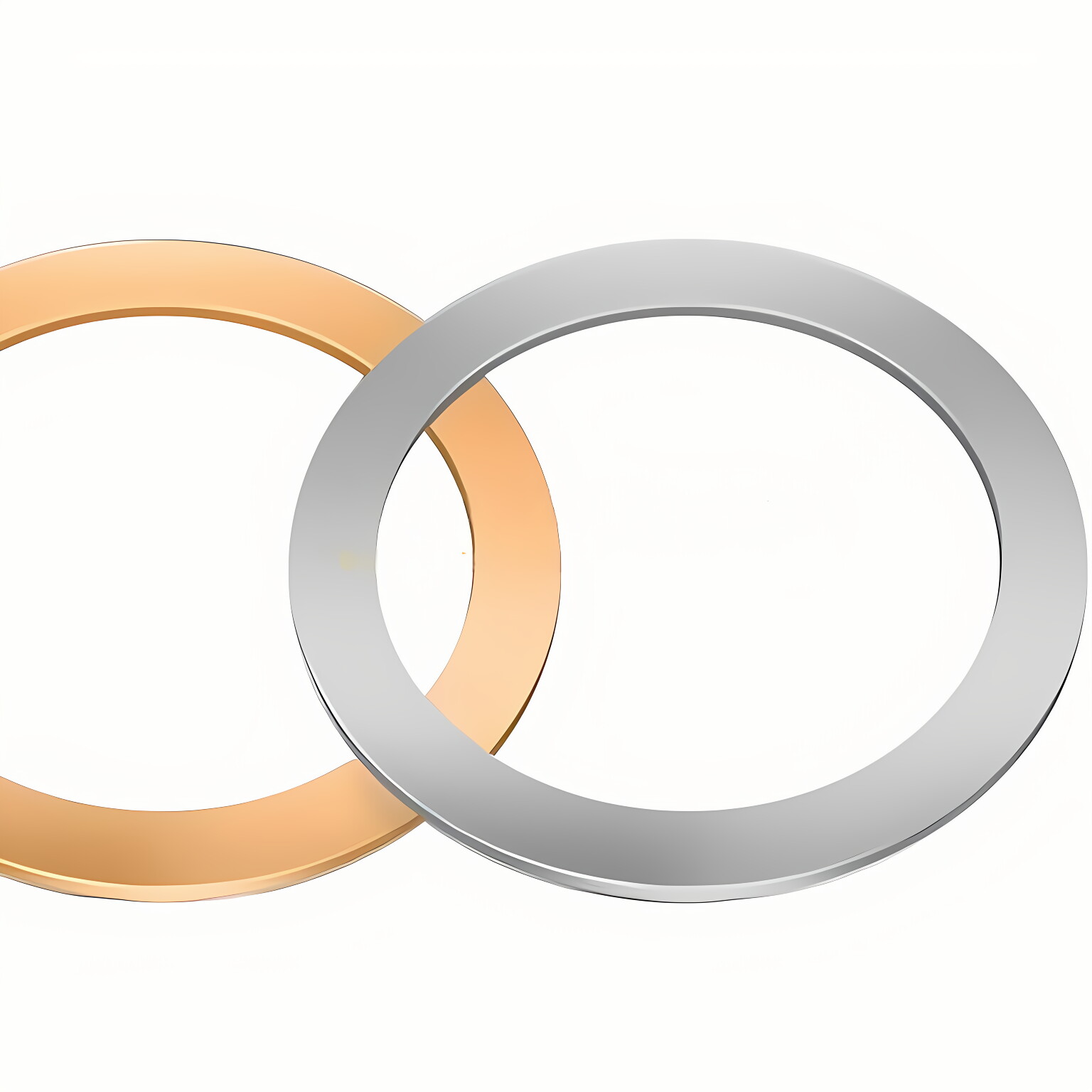
Pain point: Procurement specialists often order these gaskets based on flange size alone, neglecting material temper and plating thickness—two variables that shift optimal torque significantly.
Solution: Request detailed material certificates from your supplier. Ningbo Kaxite Sealing Materials Co., Ltd. ships every batch with full traceability, helping your team apply the correct torque from day one.
| Temper | Silver Plating | Typical Seating Stress (MPa) |
|---|---|---|
| Annealed (soft) | 3–5 µm | 30–50 |
| Half-hard | 3–5 µm | 60–90 |
| Full-hard | 3–5 µm | 100–130 |
No universal torque value exists for these gaskets because the answer depends on flange geometry, bolt grade, lubrication, and the number of tightening passes. What is the right torque for a ConFlat (CF) flange? A DN40 CF with annealed OFHC silver-plated gasket typically requires 12–15 N·m on M6 bolts, but switching to a half-hard gasket can increase that to 18–22 N·m. Lubrication reduces friction scatter—molybdenum disulfide paste on threads can lower required torque by 20%, but over-lubrication leads to bolt overload.
Pain point: Maintenance crews often reuse old torque values from generic charts, unaware that silver plating thickness and copper hardness have changed with the new batch.
Solution: Adopt a systematic approach using bolt stress calculations. Our engineers at Ningbo Kaxite Sealing Materials Co., Ltd. provide downloadable torque calculators tailored to your flange and gasket combination, eliminating guesswork.
| Flange Type | Nominal Size | Bolt Size | Recommended Torque (N·m) |
|---|---|---|---|
| CF (ConFlat) | DN40 | M6 | 14–18 |
| CF | DN100 | M8 | 22–28 |
| ISO-K | DN63 | M8 | 18–24 |
Getting accurate torque specifications for silver plated OFHC copper gaskets starts with a methodical assembly process. Begin by inspecting flange surfaces—any radial scratches deeper than 20% of the plating thickness can compromise sealing. Clean both faces with isopropyl alcohol. Finger-tighten all bolts, then follow a star-pattern cross-tightening sequence in at least three progressive steps: 30%, 60%, and 100% of target torque. For annealed gaskets, the final pass compresses the copper to approximately 70% of its original thickness, at which point the silver layer fully coats the asperities.
Pain point: In production environments, speed often overrides procedure, leading to skipped torque increments or out-of-sequence tightening.
Solution: Create a laminated torque-sequence card for each flange size and bolt configuration. Ningbo Kaxite includes these visual aids with qualifying orders, turning complex procedures into foolproof routines.
Even experienced teams misinterpret “What are the torque specifications for silver plated OFHC copper gaskets?” by focusing solely on the number. They neglect dynamic effects like bolt relaxation—after initial tightening, copper gaskets can lose 5–10% of preload within hours due to creep. A re-torque after the first thermal cycle is essential. Another mistake is mixing silver-plated gaskets with stainless steel flanges that have a different thermal expansion coefficient; differential movement loosens bolts. Always specify matched material sets from a single source.
Solution: Ningbo Kaxite offers thermally matched flange-gasket kits, and we pre-apply anti-seize compound on bolt threads to maintain consistent torque over time.
Q: What are the torque specifications for silver plated OFHC copper gaskets used in ultra-high vacuum systems below 10^-9 mbar?
A: For UHV, we recommend starting at the lower end of the seating stress range (30 MPa) for annealed gaskets. On a typical CF flange, that translates to about 10–12 N·m for M4 bolts and 14–16 N·m for M6. Always verify the silver plating integrity after bakeout. Our technical team at Ningbo Kaxite Sealing Materials Co., Ltd. can provide a custom torque sequence for your specific chamber design.
Q: How do I adjust torque specifications when switching from OFHC copper gaskets to silver plated OFHC copper gaskets?
A: The silver plating reduces friction, so you may need to lower torque by 5–8% compared to bare copper. However, the exact adjustment depends on the plating thickness. Send us your previous torque values, and we’ll calculate the optimal new specification free of charge. This is part of the support every customer receives when purchasing from Ningbo Kaxite.
Procurement professionals searching for “What are the torque specifications for silver plated OFHC copper gaskets?” often discover that the real answer lies in partnering with a supplier who understands the full application picture. Ningbo Kaxite Sealing Materials Co., Ltd. goes beyond simply manufacturing gaskets—we validate torque recommendations on a flange dynamometer, publishing the results in our application notes. Our silver plated OFHC copper gaskets undergo 100% dimensional inspection and hardness testing, so the torque values we provide are backed by batch-specific data. Additionally, we offer on-site torque training for maintenance teams, bridging the gap between catalog numbers and leak-free seals.
Still wondering about the right torque for that custom vacuum chamber or cryogenic coupling? Our engineers are ready to analyze your drawings and produce a detailed assembly specification. With 24-hour technical response and global shipping, we make sure your critical seals never become the bottleneck.
At Ningbo Kaxite Sealing Materials Co., Ltd., we specialize in high-integrity sealing solutions for the most demanding industries—from aerospace to semiconductor manufacturing. Our silver plated OFHC copper gaskets are produced under ISO 9001:2015 certified processes, with full material traceability and in-house torque testing. Whether you need a standard CF gasket or a custom-designed metallic seal, our team delivers precision components that keep your systems running leak‑free. For expert guidance on torque specifications or to request a quote, visit https://www.spiral-wound-gasket.com or reach our technical support directly at [email protected].
Li, H., et al., 2018. “Sealing performance of OFHC copper gaskets under variable bolt preload.” Journal of Vacuum Science & Technology A, 36(4).
Reid, J. and Barnard, L., 2016. “Torque relaxation in copper gaskets: an experimental study.” Vacuum, 131, pp. 234–241.
Baker, M., 2019. “Silver plating effects on gasket friction coefficients.” Surface and Coatings Technology, 371, pp. 45–53.
Chen, W., 2020. “Optimization of bolt torque for metallic seals in ultra-high vacuum.” Fusion Engineering and Design, 155, 111552.
Tomaru, T., et al., 2017. “Evaluation of silver-plated OFHC copper gaskets for cryogenic applications.” Cryogenics, 88, pp. 12–18.
Grenier, R., 2015. “Finite element analysis of gasket contact stress in conflat flanges.” Journal of Pressure Vessel Technology, 137(3), 031204.
Nagao, M. and Yamamoto, K., 2021. “Influence of plating thickness on sealing characteristics of OFHC gaskets.” Applied Surface Science, 542, 148599.
Patel, S., 2022. “Practical guide to torque assembly sequences for metal gaskets.” Sealing Technology, 2022(4), pp. 5–8.
Fernandes, A., et al., 2019. “Creep behavior of oxygen-free copper at ambient temperature.” Materials Science and Engineering: A, 748, pp. 38–46.
Ishida, Y., 2018. “Leak detection methods correlated with gasket torque accuracy.” Measurement Science and Technology, 29(11), 115019.